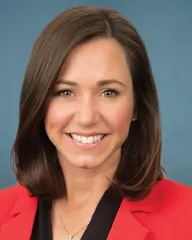
Katie Boyd Britt
U.S. Senator for Alabama (Republican). In the Senate since 2023.
What they work on
- Finance and Financial Sector6 bills
- Immigration4 bills
- Government Operations and Politics3 bills
What Katie Boyd Britt did
The biggest votes
One Big Beautiful Bill Act
This bill reduces taxes, reduces or increases spending for various federal programs, increases the statutory debt limit, and otherwise addresses agencies and programs throughout the federal government.
What this bill does
Every Democrat voted no; nearly every Republican voted yes.
Secure America Act
This bill provides funding to the Department of Homeland Security (DHS), U.S. Customs and Border Protection (CBP), and U.S. Immigration and Customs Enforcement (ICE) through FY2029 for immigration enforcement, border security, and related activities.
What this bill does
Nearly every Democrat voted no; nearly every Republican voted yes.
Continuing Appropriations, Agriculture, Legislative Branch, Military Construction and Veterans Affairs, and Extensions Act, 2026
This bill ends the government shutdown by providing FY2026 continuing appropriations for most federal agencies through January 30, 2026, and providing appropriations through the end of FY2026 for agriculture, military construction and veterans affairs, and legislative branch programs.
What this bill does
Most Democrats voted no; nearly every Republican voted yes.
What else they did
An amendment to the Protect College Sports Act of 2026
To establish certain standards with respect to coaches of varsity sports teams.
Laken Riley Act
This act requires the Department of Homeland Security (DHS) to detain certain non-U.S. nationals (aliens under federal law) who have been arrested for burglary, theft, larceny, shoplifting, assault of a law enforcement officer, or any crime that results in death or serious bodily injury to another person.
What this bill does
53 cosponsors, 6 of them from the other party.
Lulu’s Law
This act requires the Federal Communications Commission to issue an order explicitly permitting the transmission of wireless emergency alerts to mobile phones in the event of a shark attack.
What this bill does
9 cosponsors, 4 of them from the other party.
Peter Hegseth, of Tennessee, to be Secretary of Defense
Every Democrat voted no; nearly every Republican voted yes.
Laken Riley Act
Money
Biggest PAC givers: Medical Device Manufacturers Association PAC and Coca-cola Bottling Company United, Inc. Committee for Good Government
Raised $2.7 million in 2025–26, through June 30, 2026; 16% came from PACs and other political committees.
JP Morgan Chase & Company
Their spouse's account.
U.S. Senate Office of Public Records — Electronic Financial Disclosures (eFD) ↗
Votes through September 30, 2026. Campaign money through June 30, 2026.
In numbers
894 of 915 recorded votes97.7%
818 of 820 votes where the two parties disagreed99.8%
Bills since January 2025
- Sponsored
- 30
- Sponsored and became law
- 2
- Cosponsored
- 346
| 2023 | 2 |
|---|---|
| 2024 | 1 |
| 2025 | 22 |
| 2026 | 1 |
Most recent trade: January 28, 2026[filing]. From 5 stock trade reports.
- Individuals$2,232,328.61 (82.5%)
- PACs and other committees$437,050 (16.1%)
- Other receipts$37,181.90 (1.4%)
Cash on hand on June 30, 2026: $5.24 million
Sources: United States Senate, Senate roll call votes, 119th Congress, 2nd Session (2026), U.S. Government Publishing Office, Bill status bulk data: Senate bills, 119th Congress, Bill status bulk data: House joint resolutions, 119th Congress, Bill status bulk data: Senate joint resolutions, 119th Congress, Bill status bulk data: House concurrent resolutions, 119th Congress, Bill status bulk data: Senate concurrent resolutions, 119th Congress, Bill status bulk data: House simple resolutions, 119th Congress, Bill status bulk data: Senate simple resolutions, 119th Congress, U.S. Senate Office of Public Records, House financial disclosure, House financial disclosure index, reporting year 2025 (2025FD.zip), House financial disclosure index, reporting year 2024 (2024FD.zip), House financial disclosure index, reporting year 2023 (2023FD.zip), House financial disclosure index, reporting year 2022 (2022FD.zip), House financial disclosure index, reporting year 2021 (2021FD.zip), House financial disclosure index, reporting year 2020 (2020FD.zip), House financial disclosure index, reporting year 2019 (2019FD.zip), Federal Election Commission, Contributions and independent expenditures from committees to candidates, 2025–2026 (pas226.zip), Committee master, 2025–2026 (cm26.zip)
All votes since January 2025Voted yes or no on 894 of 915 recorded votesShow details
Votes since January 2025
Senate votes from January 9, 2025, to September 30, 2026
- Attendance
- Voted yes or no on 894 of 915 (97.7%) recorded votes.Did not vote 21 times.
- With their party
- Voted with most of their party on 818 of 820 (99.8%) votes where the two parties disagreed.
Sources: United States Senate, Senate roll call votes, 119th Congress, 2nd Session (2026)
Most recent votes
| Date | Question | Bill | Their vote | Result |
|---|---|---|---|---|
| Sep 30, 2026 | Confirmation Confirmation: Keith Sonderling, of F.L., to be Secretary of Labor | — | Yes | Confirmed 47 to 41[source] |
| Sep 30, 2026 | Vote to end debate (three-fifths needed) Motion to Invoke Cloture: Keith Sonderling to be Secretary of Labor | — | Yes | Agreed to 53 to 47[source] |
| Sep 30, 2026 | Vote to start debate (three-fifths needed) Motion to Invoke Cloture on the Motion to Proceed to H.R. 9340 What the bill doesRatepayer Protection Act
The bill requires state utility regulators and nonregulated utilities to consider implementing a standard to hold certain large-load customers responsible for the costs associated with any generation, transmission, or distribution upgrade of electric service necessary to serve such customers. A large-load customer means a non-residential electric consumer that enters, or requests to enter, an agreement concerning the sale of electric energy primarily to operate information technology infrastructure and related systems pertaining to data storage and computational applications and services (e.g., data centers) that have a peak electric demand of 100 megawatts or more at a single site or campus.
Specifically, the bill requires states to consider implementing a federal standard for large-load customers. The standard must require rates charged by electric utilities for providing electric service to a large-load customer to be designed to recover from the large-load customer the full, incremental cost of any generation, transmission, or distribution upgrade necessary to serve such customer. This rate must include the costs that would be incurred if the large-load customer terminates an agreement with the electric utility pertaining to the sale of electric energy or otherwise ceases the purchase of energy from the electric utility.
Under the standard, an electric utility must require the large-load customer to provide to the utility financial assurances or contributions to cover the cost of any generation, transmission, or distribution upgrade that is necessary to serve the load of a large-load customer before the utility makes any generation, transmission, or distribution upgrade. | H.R. 9340 | Yes | Rejected 57 to 43 (three-fifths needed)[source] |
| Sep 30, 2026 | Vote to start debate (three-fifths needed) Motion to Invoke Cloture on the Motion to Proceed: H.R. 7008 What the bill doesStop Insider Trading Act
This bill generally prohibits Members of Congress and their spouses and dependent children from purchasing stocks and requires public notice before these individuals may sell stocks.
Specifically, Members of Congress and the spouses and dependent children of Members of Congress may not purchase covered investments. Between 7 and 14 days before a Member or a covered spouse or dependent sells a covered investment, the relevant Member must file public notice of the intent to sell with the Clerk of the House of Representatives or the Secretary of the Senate, as appropriate. The Clerk or Secretary must publish this notice online. If the individual decides not to sell the covered investment, the notice must be withdrawn.
Under the bill, a covered investment is a security issued by a publicly traded company or a comparable economic interest. Some investments are exempt, including interest in a widely held investment fund and certain investments held in a trust.
Violations of these provisions are subject to a fee and, in the case of a purchase, a requirement to sell the covered investment. The fee must equal (1) the greater of $2,000 or 10% of the transaction value, and (2) any net gain realized from the transaction during a specified period. The fee may not be paid using campaign donations or Members’ official allowances.
Certain transactions by covered spouses and dependents are exempt, including transactions made on behalf of another person or made as part of compensation from the individual’s employer. | H.R. 7008 | Yes | Rejected 53 to 47 (three-fifths needed)[source] |
| Sep 29, 2026 | Motion to Discharge Motion to Discharge S. Res. 852 What the bill doesThis resolution requests that the Department of State provide Congress with an unclassified statement regarding Israel's human rights practices.
The resolution specifies that the statement should include certain elements, including (1) all credible information concerning the alleged killing of nine specified U.S. citizens and any other U.S. citizens by the Israeli Defense Forces, Israeli security forces, or Israeli settlers in 2022 or later; (2) all credible information concerning the identities of potential suspects in the killings; and (3) details on any steps taken by Israeli authorities to investigate the killings and hold accountable those responsible.
The statement should also include other elements, such as assessments of U.S. citizens currently held in Israeli prisons and the human rights situation of Palestinian children in Israeli military detention in the West Bank. | S.Res. 852 | No | Rejected 47 to 51[source] |
| Sep 29, 2026 | Vote to start debate Motion to Proceed to S.J. Res. 197 | S.J.Res. 197 | No | Rejected 48 to 51[source] |
| Sep 28, 2026 | Final passage S. 4668, as amended What the bill doesProtect College Sports Act of 2026
This bill establishes requirements for name, image, or likeness (NIL) agreements for college student athletes and provides a limited antitrust exemption for schools and conferences to pool and sell certain college sports media rights. The requirements address elements of the court-approved agreement to settle In re College Athlete NIL Litigation (i.e., House settlement).
First, the bill statutorily prohibits institutions, conferences, or interstate intercollegiate athletic associations (e.g., the National Collegiate Athletic Association [NCAA]) from restricting student athletes from entering NIL agreements (subject to specified limitations). Students must report to their institution NIL compensation greater than $600.
The bill requires agents to register with a state and caps agent endorsement contract fees at 5%.
The bill also provides student athletes with one transfer without losing athletic eligibility and restricts football personnel from becoming the head football coach at a different institution during the same season.
Further, the bill prohibits institutions, conferences, or specified entities acting for the benefit of an institution from providing athletes with compensation that circumvents the limit on sharing revenue with student athletes established under the House settlement. The bill also makes the limit permanent and provides for an annual inflation adjustment.
The bill generally prohibits Division I conferences from reducing the number of varsity or Olympic sports teams that a member institution must sponsor. Specifically, large institutions ($80 million or more in annual athletics revenue) must offer and maintain at least as many grant-in-aid opportunities and roster spots for sports that do not generate positive net revenue as the institution provided during academic year 2024-25. The bill provides for a waiver of this requirement under certain circumstances of financial hardship and the requirements expire nine years after the enactment of the bill.
Additionally, the bill establishes (subject to specified conditions) a limited antitrust exemption for institutions or conferences that form joint agreements to transfer their sports telecasting rights to a third party. Such an agreement requires participation from at least 75% of the institutions in the Football Bowl Subdivision. | S. 4668 | Yes | Passed 77 to 22[source] |
| Sep 28, 2026 | Amendment Booker Amdt. No. 6835 S.Amdt. 6835: To establish certain standards with respect to coaches of varsity sports teams. What the bill doesProtect College Sports Act of 2026
This bill establishes requirements for name, image, or likeness (NIL) agreements for college student athletes and provides a limited antitrust exemption for schools and conferences to pool and sell certain college sports media rights. The requirements address elements of the court-approved agreement to settle In re College Athlete NIL Litigation (i.e., House settlement).
First, the bill statutorily prohibits institutions, conferences, or interstate intercollegiate athletic associations (e.g., the National Collegiate Athletic Association [NCAA]) from restricting student athletes from entering NIL agreements (subject to specified limitations). Students must report to their institution NIL compensation greater than $600.
The bill requires agents to register with a state and caps agent endorsement contract fees at 5%.
The bill also provides student athletes with one transfer without losing athletic eligibility and restricts football personnel from becoming the head football coach at a different institution during the same season.
Further, the bill prohibits institutions, conferences, or specified entities acting for the benefit of an institution from providing athletes with compensation that circumvents the limit on sharing revenue with student athletes established under the House settlement. The bill also makes the limit permanent and provides for an annual inflation adjustment.
The bill generally prohibits Division I conferences from reducing the number of varsity or Olympic sports teams that a member institution must sponsor. Specifically, large institutions ($80 million or more in annual athletics revenue) must offer and maintain at least as many grant-in-aid opportunities and roster spots for sports that do not generate positive net revenue as the institution provided during academic year 2024-25. The bill provides for a waiver of this requirement under certain circumstances of financial hardship and the requirements expire nine years after the enactment of the bill.
Additionally, the bill establishes (subject to specified conditions) a limited antitrust exemption for institutions or conferences that form joint agreements to transfer their sports telecasting rights to a third party. Such an agreement requires participation from at least 75% of the institutions in the Football Bowl Subdivision. | S. 4668 | Yes | Rejected 47 to 52[source] |
| Sep 28, 2026 | Amendment Booker Amdt. No. 6805 S.Amdt. 6805: To increase the limitation on funding for post-eligibility insurance and catastrophic injury for student athletes. What the bill doesProtect College Sports Act of 2026
This bill establishes requirements for name, image, or likeness (NIL) agreements for college student athletes and provides a limited antitrust exemption for schools and conferences to pool and sell certain college sports media rights. The requirements address elements of the court-approved agreement to settle In re College Athlete NIL Litigation (i.e., House settlement).
First, the bill statutorily prohibits institutions, conferences, or interstate intercollegiate athletic associations (e.g., the National Collegiate Athletic Association [NCAA]) from restricting student athletes from entering NIL agreements (subject to specified limitations). Students must report to their institution NIL compensation greater than $600.
The bill requires agents to register with a state and caps agent endorsement contract fees at 5%.
The bill also provides student athletes with one transfer without losing athletic eligibility and restricts football personnel from becoming the head football coach at a different institution during the same season.
Further, the bill prohibits institutions, conferences, or specified entities acting for the benefit of an institution from providing athletes with compensation that circumvents the limit on sharing revenue with student athletes established under the House settlement. The bill also makes the limit permanent and provides for an annual inflation adjustment.
The bill generally prohibits Division I conferences from reducing the number of varsity or Olympic sports teams that a member institution must sponsor. Specifically, large institutions ($80 million or more in annual athletics revenue) must offer and maintain at least as many grant-in-aid opportunities and roster spots for sports that do not generate positive net revenue as the institution provided during academic year 2024-25. The bill provides for a waiver of this requirement under certain circumstances of financial hardship and the requirements expire nine years after the enactment of the bill.
Additionally, the bill establishes (subject to specified conditions) a limited antitrust exemption for institutions or conferences that form joint agreements to transfer their sports telecasting rights to a third party. Such an agreement requires participation from at least 75% of the institutions in the Football Bowl Subdivision. | S. 4668 | No | Rejected 49 to 50[source] |
| Sep 28, 2026 | Amendment Kennedy Amdt. No. 6760 S.Amdt. 6760: To limit price increases for college athletics tickets. What the bill doesProtect College Sports Act of 2026
This bill establishes requirements for name, image, or likeness (NIL) agreements for college student athletes and provides a limited antitrust exemption for schools and conferences to pool and sell certain college sports media rights. The requirements address elements of the court-approved agreement to settle In re College Athlete NIL Litigation (i.e., House settlement).
First, the bill statutorily prohibits institutions, conferences, or interstate intercollegiate athletic associations (e.g., the National Collegiate Athletic Association [NCAA]) from restricting student athletes from entering NIL agreements (subject to specified limitations). Students must report to their institution NIL compensation greater than $600.
The bill requires agents to register with a state and caps agent endorsement contract fees at 5%.
The bill also provides student athletes with one transfer without losing athletic eligibility and restricts football personnel from becoming the head football coach at a different institution during the same season.
Further, the bill prohibits institutions, conferences, or specified entities acting for the benefit of an institution from providing athletes with compensation that circumvents the limit on sharing revenue with student athletes established under the House settlement. The bill also makes the limit permanent and provides for an annual inflation adjustment.
The bill generally prohibits Division I conferences from reducing the number of varsity or Olympic sports teams that a member institution must sponsor. Specifically, large institutions ($80 million or more in annual athletics revenue) must offer and maintain at least as many grant-in-aid opportunities and roster spots for sports that do not generate positive net revenue as the institution provided during academic year 2024-25. The bill provides for a waiver of this requirement under certain circumstances of financial hardship and the requirements expire nine years after the enactment of the bill.
Additionally, the bill establishes (subject to specified conditions) a limited antitrust exemption for institutions or conferences that form joint agreements to transfer their sports telecasting rights to a third party. Such an agreement requires participation from at least 75% of the institutions in the Football Bowl Subdivision. | S. 4668 | No | Rejected 42 to 54 (three-fifths needed)[source] |
Votes on bills they sponsored
| Date | Question | Their vote | Result |
|---|---|---|---|
| May 20, 2026 | Passage under fast-track rules (two-thirds needed) Lulu’s Law | Not in the House | Passed 401 to 6[source] |
| Date | Question | Their vote | Result |
|---|---|---|---|
| Jan 22, 2025 | Final passage Laken Riley Act | Not in the House | Passed 263 to 156[source] |
| Jan 20, 2025 | Final passage S. 5, As Amended | Yes | Passed 64 to 35[source] |
| Jan 20, 2025 | Amendment Ernst Amdt No. 8, As Amended S.Amdt. 8: To include crimes resulting in death or serious bodily injury to the list of offenses that, if committed by an inadmissible… morealien, require mandatory detention. | Yes | Agreed to 75 to 24[source] |
| Jan 17, 2025 | Vote to end debate (three-fifths needed) Motion to Invoke Cloture: S. 5 | Yes | Agreed to 61 to 35 (three-fifths needed)[source] |
| Jan 15, 2025 | Amendment Coons Amdt. No. 23 S.Amdt. 23: To strike the section that authorizes State attorneys general to sue Federal immigration authorities for alleged violations… morerelating to the detention of aliens. | No | Rejected 46 to 49[source] |
| Jan 15, 2025 | Amendment Cornyn Amdt. No. 14 S.Amdt. 14: To expand the list of criminal offenses that subject inadmissible aliens to mandatory detention. | Yes | Agreed to 70 to 25[source] |
| Jan 13, 2025 | Vote to start debate Motion to Proceed to S. 5 | Yes | Agreed to 82 to 10[source] |
| Jan 9, 2025 | Vote to start debate (three-fifths needed) Motion to Invoke Cloture: Motion to Proceed to S. 5 | Yes | Agreed to 84 to 9 (three-fifths needed)[source] |
Sources: U.S. Government Publishing Office, Bill status XML for S. 5 (119th Congress)
All billsSponsored 30; 2 became lawShow details
Bills since January 2025
- Sponsored
- 30 bills and resolutions; 2 became law
- Cosponsored
- 346 bills and resolutionsNot counting 1 cosponsorship they later withdrew.
Sources: U.S. Government Publishing Office, Bill status bulk data: Senate bills, 119th Congress, Bill status bulk data: House joint resolutions, 119th Congress, Bill status bulk data: Senate joint resolutions, 119th Congress, Bill status bulk data: House concurrent resolutions, 119th Congress, Bill status bulk data: Senate concurrent resolutions, 119th Congress, Bill status bulk data: House simple resolutions, 119th Congress, Bill status bulk data: Senate simple resolutions, 119th Congress
Sponsored, most recently introduced first
Introduced September 22, 2026. In committee; no vote yet. Last action on September 22, 2026.[source]
Keep Our Communities Safe Act of 2026
Introduced August 6, 2026. In committee; no vote yet. Last action on August 6, 2026.[source]
Introduced August 3, 2026. In committee; no vote yet. Last action on August 3, 2026.[source]
A resolution honoring and celebrating National Boys and Girls Club Week.
Introduced July 14, 2026. In committee; no vote yet. Last action on July 14, 2026.[source]
Introduced June 3, 2026. In committee; no vote yet. Last action on June 3, 2026.[source]
Mandatory E-Verify Act of 2026
Introduced May 21, 2026. In committee; no vote yet. Last action on May 21, 2026.[source]
Introduced May 18, 2026. In committee; no vote yet. Last action on May 18, 2026.[source]
Introduced March 23, 2026. Submitted in the Senate, considered, and agreed to without amendment and with a preamble by Unanimous Consent. (consideration: CR S1560; text: CR S1546-1547) Last action on March 23, 2026.[source]
Fighting Trade Cheats Act of 2026
Introduced February 9, 2026. In committee; no vote yet. Last action on February 9, 2026.[source]
Improving Access to Small Business Information Act
Introduced December 10, 2025. In committee; no vote yet. Last action on December 10, 2025.[source]
Introduced November 20, 2025. In committee; no vote yet. Last action on November 20, 2025.[source]
Introduced November 18, 2025. In committee; no vote yet. Last action on November 18, 2025.[source]
Introduced September 29, 2025. In committee; no vote yet. Last action on September 29, 2025.[source]
Introduced July 31, 2025. In committee; no vote yet. Last action on July 31, 2025.[source]
Introduced July 30, 2025. Placed on Senate Legislative Calendar under General Orders. Calendar No. 317. Last action on February 9, 2026.[source]
…and 15 more sponsored items.
Most recent cosponsorships
Cosponsored September 30, 2026 (original cosponsor). Submitted in the Senate, considered, and agreed to without amendment and with a preamble by Unanimous Consent. (consideration: CR S5299; text: CR S5270) Last action on September 30, 2026.[source]
A resolution designating October 10, 2026, as "American Girls in Sports Day".
Cosponsored September 30, 2026 (original cosponsor). In committee; no vote yet. Last action on September 30, 2026.[source]
Cosponsored September 30, 2026 (original cosponsor). In committee; no vote yet. Last action on September 30, 2026.[source]
Wildfire Reduction Market Expansion Act of 2026
Cosponsored September 30, 2026. In committee; no vote yet. Last action on July 22, 2026.[source]
A resolution designating September 2026 as "National Literacy Month".
Cosponsored September 29, 2026 (original cosponsor). Submitted in the Senate, considered, and agreed to without amendment and with a preamble by Unanimous Consent. (consideration: CR S5186) Last action on September 29, 2026.[source]
Cosponsored September 28, 2026 (original cosponsor). Submitted in the Senate, considered, and agreed to without amendment and with a preamble by Unanimous Consent. (consideration: CR S5123; text: CR S5075) Last action on September 28, 2026.[source]
Cosponsored September 28, 2026 (original cosponsor). Submitted in the Senate, considered, and agreed to without amendment and with a preamble by Unanimous Consent. (consideration: CR S5064-5065; text: CR S5074-5075) Last action on September 28, 2026.[source]
Cosponsored September 28, 2026 (original cosponsor). In committee; no vote yet. Last action on September 28, 2026.[source]
Cosponsored September 24, 2026 (original cosponsor). In committee; no vote yet. Last action on September 24, 2026.[source]
Cosponsored September 24, 2026 (original cosponsor). In committee; no vote yet. Last action on September 24, 2026.[source]
…and 336 more cosponsorships.
Campaign money$2.71 million raisedShow details
Campaign money, 2025 and 2026
Senate campaign, with activity through June 30, 2026. See it on FEC.gov ↗
The campaign's totals
- Raised
- $2,706,560.51
- Spent
- $1,580,922.40
- Cash on hand on June 30, 2026
- $5,235,186.81
- Debts
- $30,327
Where the money came from
- Individuals
- $2,232,328.61
- PACs and other committees
- $437,050
Top contributing committees
The FEC reports $437,050 from PACs and other committees. The largest givers:
| Committee | Amount |
|---|---|
| Medical Device Manufacturers Association PACPAC, 2 contributions | $10,000 |
| Coca-cola Bottling Company United, Inc. Committee for Good GovernmentPAC, 2 contributions | $7,500 |
| The Hartford Insurance Group, Inc. Federal PAC (AKA HARTFORD ADVOCATES FEDERAL FUND)PAC, 3 contributions | $7,000 |
| Unitedhealth Group Incorporated PAC (UNITEDHEALTH GROUP PAC)PAC, 3 contributions | $6,500 |
| Amgen Inc. Political Action CommitteePAC, 3 contributions | $5,000 |
| Principal Life Insurance Company Political Action CommitteePAC, 3 contributions | $5,000 |
| U.s. Bancorp Federal Political Action CommitteePAC, 3 contributions | $5,000 |
| American Council of Life Insurers Political Action CommitteePAC, 2 contributions | $5,000 |
| Appraisal Institute PAC (AI PAC)PAC, 2 contributions | $5,000 |
| Cencora, Inc. PACPAC, 2 contributions | $5,000 |
Sources: Federal Election Commission, Contributions and independent expenditures from committees to candidates, 2025–2026 (pas226.zip), Committee master, 2025–2026 (cm26.zip)
Stock trades and holdings26 purchases and salesShow details
Stock trades and holdings
Filed 5 stock trade reports from 2019 to 2026.
- 2026
- 1
- 2025
- 22
- 2024
- 1
- 2023
- 2
| Trade date | Owner | Asset | Type | Amount (range) | Reported |
|---|---|---|---|---|---|
| Jan 28, 2026 | Spouse | JP Morgan Chase & Company | Sale | $1,001 – $15,000 | Jan 29, 2026[filing] |
| Nov 7, 2025 | Spouse | Nvidia Corp | Partial sale | $1,001 – $15,000 | Jan 26, 2026[filing]Reported 80 days after the trade; the law allows 45. |
| Nov 7, 2025 | Spouse | Apple Inc | Partial sale | $1,001 – $15,000 | Jan 26, 2026[filing]Reported 80 days after the trade; the law allows 45. |
| Nov 7, 2025 | Spouse | Alphabet Cl C | Partial sale | $1,001 – $15,000 | Jan 26, 2026[filing]Reported 80 days after the trade; the law allows 45. |
| Nov 7, 2025 | Spouse | United Parcel Service | Purchase | $1,001 – $15,000 | Jan 26, 2026[filing]Reported 80 days after the trade; the law allows 45. |
| Nov 7, 2025 | Spouse | Amazon.com Inc | Partial sale | $1,001 – $15,000 | Jan 26, 2026[filing]Reported 80 days after the trade; the law allows 45. |
| Nov 7, 2025 | Spouse | Visa Inc | Purchase | $1,001 – $15,000 | Jan 26, 2026[filing]Reported 80 days after the trade; the law allows 45. |
| Apr 30, 2025 | Spouse | Amazon.com Inc | Purchase | $1,001 – $15,000 | Jan 26, 2026[filing]Reported 271 days after the trade; the law allows 45. |
| Apr 30, 2025 | Spouse | Apple Inc | Purchase | $1,001 – $15,000 | Jan 26, 2026[filing]Reported 271 days after the trade; the law allows 45. |
| Apr 30, 2025 | Spouse | Unitedhealth Group Inc | Sale | $1,001 – $15,000 | Jan 26, 2026[filing]Reported 271 days after the trade; the law allows 45. |
| Apr 30, 2025 | Spouse | Nvidia Corp | Purchase | $1,001 – $15,000 | Jan 26, 2026[filing]Reported 271 days after the trade; the law allows 45. |
| Apr 30, 2025 | Spouse | Exxon Mobil Corp | Sale | $1,001 – $15,000 | Jan 26, 2026[filing]Reported 271 days after the trade; the law allows 45. |
| Apr 14, 2025 | Spouse | Exxon Mobil Corp | Purchase | $1,001 – $15,000 | Jan 26, 2026[filing]Reported 287 days after the trade; the law allows 45. |
| Apr 14, 2025 | Spouse | JP Morgan Chase & Company | Purchase | $1,001 – $15,000 | Jan 26, 2026[filing]Reported 287 days after the trade; the law allows 45. |
| Apr 14, 2025 | Spouse | Alphabet Cl C | Purchase | $1,001 – $15,000 | Jan 26, 2026[filing]Reported 287 days after the trade; the law allows 45. |
| Apr 14, 2025 | Spouse | EOG Resources, Inc. Common Stock | Purchase | $1,001 – $15,000 | Jan 26, 2026[filing]Reported 287 days after the trade; the law allows 45. |
| Apr 14, 2025 | Spouse | Apple Inc | Purchase | $1,001 – $15,000 | Jan 26, 2026[filing]Reported 287 days after the trade; the law allows 45. |
| Apr 14, 2025 | Spouse | Amazon.com Inc | Purchase | $1,001 – $15,000 | Jan 26, 2026[filing]Reported 287 days after the trade; the law allows 45. |
| Apr 14, 2025 | Spouse | Walmart Inc | Purchase | $1,001 – $15,000 | Jan 26, 2026[filing]Reported 287 days after the trade; the law allows 45. |
| Apr 14, 2025 | Spouse | Visa Inc | Purchase | $1,001 – $15,000 | Jan 26, 2026[filing]Reported 287 days after the trade; the law allows 45. |
| Apr 14, 2025 | Spouse | Microsoft Corp | Purchase | $1,001 – $15,000 | Jan 26, 2026[filing]Reported 287 days after the trade; the law allows 45. |
| Apr 14, 2025 | Spouse | Unitedhealth Group Inc | Purchase | $1,001 – $15,000 | Jan 26, 2026[filing]Reported 287 days after the trade; the law allows 45. |
| Apr 14, 2025 | Spouse | Nvidia Corp | Purchase | $1,001 – $15,000 | Jan 26, 2026[filing]Reported 287 days after the trade; the law allows 45. |
| Jul 24, 2024 | Joint | OneWater Marine Inc. - Class A Common Stock | Sale | $1,001 – $15,000 | Jul 29, 2024[filing] |
| Dec 14, 2023 | Spouse | 181-Fairhope Ave 2023, LLC Company: 181-Fairhope Ave 2023, LLC (Daphne, AL) Description: Investment and development of real property in Alabama | Purchase | $15,001 – $50,000 | Dec 15, 2023[filing] |
Showing the 25 most recent; 1 more trade in the linked filings.
Sources: U.S. Senate Office of Public Records, House financial disclosure, House financial disclosure index, reporting year 2025 (2025FD.zip), House financial disclosure index, reporting year 2024 (2024FD.zip), House financial disclosure index, reporting year 2023 (2023FD.zip), House financial disclosure index, reporting year 2022 (2022FD.zip), House financial disclosure index, reporting year 2021 (2021FD.zip), House financial disclosure index, reporting year 2020 (2020FD.zip), House financial disclosure index, reporting year 2019 (2019FD.zip)
Their work since January 2025Show details
Their work since January 2025
Spoke on the floor 50 times on 31 days.[source] Topics included “Trump Administration,” “Lulu's Law,” and the Veterans Accessibility Advisory Committee Act of 2025.[source]
Offered no amendments on the floor. Filed 13 that never came up for a vote.[one of them]
Sits on the Appropriations Committee (74 hearings, counting subcommittees) and the Banking, Housing, and Urban Affairs Committee (30 hearings).[Appropriations][Banking, Housing, and Urban Affairs]
Lobbyists reported $1,179,251 in 486 contributions in 2025 to their campaign or their leadership PAC, plus $107 in 1 payment to honor them.[source]
Floor speeches through October 5, 2026.
Senate Office of Public Records cannot vouch for the data or analyses derived from these data after the data have been retrieved from LDA.gov. Retrieved from LDA.gov on October 6, 2026.
Committees5 committeesShow details
Committees
- Commission on Security and Cooperation in EuropeMajority member
- Committee on AppropriationsMajority member
- Subcommittee on Commerce, Justice, Science, and Related AgenciesMajority member
- Subcommittee on Department of Homeland SecurityChair
- Subcommittee on Departments of Labor, Health and Human Services, and Education, and Related AgenciesMajority member
- Subcommittee on Energy and Water DevelopmentMajority member
- Subcommittee on State, Foreign Operations, and Related ProgramsMajority member
- Subcommittee on Transportation, Housing and Urban Development, and Related AgenciesMajority member
- Committee on Banking, Housing, and Urban AffairsMajority member
- Subcommittee on Financial Institutions and Consumer ProtectionMajority member
- Subcommittee on Housing, Transportation, and Community DevelopmentChair
- Subcommittee on Securities, Insurance, and InvestmentMajority member
- Committee on Rules and AdministrationMajority member
- Committee on the JudiciaryMajority member
- Subcommittee on Antitrust, Competition Policy, and Consumer RightsMajority member
- Subcommittee on Border Security and ImmigrationMajority member
- Subcommittee on Crime and CounterterrorismMajority member
- Subcommittee on Intellectual PropertyMajority member
Sources: Senate committee page, Committee on Appropriations — membership (committee_memberships_SSAP.xml), Committee on Banking, Housing, and Urban Affairs — membership (committee_memberships_SSBK.xml), Committee on the Judiciary — membership (committee_memberships_SSJU.xml), Committee on Rules and Administration — membership (committee_memberships_SSRA.xml)
More about themShow details
More about them
- Next election
- 2028
- Seniority
- Junior senator
- Born
- 1982
- Office in Washington
- 416 Russell Senate Office Building Washington DC 20510
Sources: U.S. Senate, Library of Congress