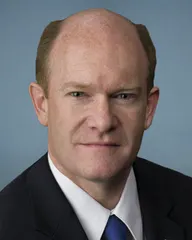
Christopher A. Coons
U.S. Senator for Delaware (Democrat). In the Senate since 2010.
What they work on
- Commerce7 bills
- International Affairs6 bills
- Immigration4 bills
What Christopher A. Coons did
The biggest votes
One Big Beautiful Bill Act
This bill reduces taxes, reduces or increases spending for various federal programs, increases the statutory debt limit, and otherwise addresses agencies and programs throughout the federal government.
What this bill does
Every Democrat voted no; nearly every Republican voted yes.
Secure America Act
This bill provides funding to the Department of Homeland Security (DHS), U.S. Customs and Border Protection (CBP), and U.S. Immigration and Customs Enforcement (ICE) through FY2029 for immigration enforcement, border security, and related activities.
What this bill does
Nearly every Democrat voted no; nearly every Republican voted yes.
Continuing Appropriations, Agriculture, Legislative Branch, Military Construction and Veterans Affairs, and Extensions Act, 2026
This bill ends the government shutdown by providing FY2026 continuing appropriations for most federal agencies through January 30, 2026, and providing appropriations through the end of FY2026 for agriculture, military construction and veterans affairs, and legislative branch programs.
What this bill does
Most Democrats voted no; nearly every Republican voted yes.
What else they did
Consolidated Appropriations Act, 2026
This bill provides FY2026 appropriations to several federal departments and agencies.
What this bill does
Bankruptcy Administration Improvement Act of 2025
This act makes several changes to the administration of bankruptcy cases, particularly by increasing amounts received by certain trustees, extending the sunset date of various fees, and extending the term of specified bankruptcy judgeships.
What this bill does
3 cosponsors, 2 of them from the other party.
Bankruptcy Administration Improvement Act of 2025
This bill makes several changes to the administration of bankruptcy cases, particularly by increasing certain fees, extending the sunset date of various fees, and extending the term of specified bankruptcy judgeships.
What this bill does
10 cosponsors, 6 of them from the other party.
An amendment to the Secure America Act
Peter Hegseth, of Tennessee, to be Secretary of Defense
Every Democrat voted no; nearly every Republican voted yes.
Money
Biggest PAC givers: Alsopac, American Federation of State County & Municipal Employees PEOPLE and 46 more
Raised $4.2 million for the 2026 election, through August 26, 2026; 34% came from PACs and other political committees.
W.L. Gore & Associates, Inc. Company: W.L. Gore & Associates, Inc. (Newark, Delaware) Description: Advanced materials manufacturing
Their spouse's account.
U.S. Senate Office of Public Records — Electronic Financial Disclosures (eFD) ↗
Votes through September 30, 2026. Campaign money through August 26, 2026.
In numbers
863 of 915 recorded votes94.3%
747 of 794 votes where the two parties disagreed94.1%
Bills since January 2025
- Sponsored
- 66
- Sponsored and became law
- 1
- Cosponsored
- 591
| 2018 | 8 |
|---|---|
| 2019 | 5 |
| 2020 | 3 |
| 2021 | 6 |
| 2022 | 1 |
| 2023 | 2 |
| 2024 | 2 |
| 2026 | 1 |
Most recent trade: August 7, 2026[filing]. From 11 stock trade reports.
- Individuals$1,989,694.63 (47.7%)
- PACs and other committees$1,408,376.74 (33.8%)
- Other receipts$770,009.94 (18.5%)
Cash on hand on August 26, 2026: $4.79 million
Other committees also gave $10,000.
Sources: United States Senate, Senate roll call votes, 119th Congress, 2nd Session (2026), U.S. Government Publishing Office, Bill status bulk data: Senate bills, 119th Congress, Bill status bulk data: House joint resolutions, 119th Congress, Bill status bulk data: Senate joint resolutions, 119th Congress, Bill status bulk data: House concurrent resolutions, 119th Congress, Bill status bulk data: Senate concurrent resolutions, 119th Congress, Bill status bulk data: House simple resolutions, 119th Congress, Bill status bulk data: Senate simple resolutions, 119th Congress, U.S. Senate Office of Public Records, House financial disclosure, House financial disclosure index, reporting year 2025 (2025FD.zip), House financial disclosure index, reporting year 2024 (2024FD.zip), House financial disclosure index, reporting year 2023 (2023FD.zip), House financial disclosure index, reporting year 2022 (2022FD.zip), House financial disclosure index, reporting year 2021 (2021FD.zip), House financial disclosure index, reporting year 2020 (2020FD.zip), House financial disclosure index, reporting year 2019 (2019FD.zip), Federal Election Commission, Contributions and independent expenditures from committees to candidates, 2025–2026 (pas226.zip), Committee master, 2025–2026 (cm26.zip)
All votes since January 2025Voted yes or no on 863 of 915 recorded votesShow details
Votes since January 2025
Senate votes from January 9, 2025, to September 30, 2026
- Attendance
- Voted yes or no on 863 of 915 (94.3%) recorded votes.Did not vote 52 times.
- With their party
- Voted with most of their party on 747 of 794 (94.1%) votes where the two parties disagreed.
Sources: United States Senate, Senate roll call votes, 119th Congress, 2nd Session (2026)
Most recent votes
| Date | Question | Bill | Their vote | Result |
|---|---|---|---|---|
| Sep 30, 2026 | Confirmation Confirmation: Keith Sonderling, of F.L., to be Secretary of Labor | — | No | Confirmed 47 to 41[source] |
| Sep 30, 2026 | Vote to end debate (three-fifths needed) Motion to Invoke Cloture: Keith Sonderling to be Secretary of Labor | — | No | Agreed to 53 to 47[source] |
| Sep 30, 2026 | Vote to start debate (three-fifths needed) Motion to Invoke Cloture on the Motion to Proceed to H.R. 9340 What the bill doesRatepayer Protection Act
The bill requires state utility regulators and nonregulated utilities to consider implementing a standard to hold certain large-load customers responsible for the costs associated with any generation, transmission, or distribution upgrade of electric service necessary to serve such customers. A large-load customer means a non-residential electric consumer that enters, or requests to enter, an agreement concerning the sale of electric energy primarily to operate information technology infrastructure and related systems pertaining to data storage and computational applications and services (e.g., data centers) that have a peak electric demand of 100 megawatts or more at a single site or campus.
Specifically, the bill requires states to consider implementing a federal standard for large-load customers. The standard must require rates charged by electric utilities for providing electric service to a large-load customer to be designed to recover from the large-load customer the full, incremental cost of any generation, transmission, or distribution upgrade necessary to serve such customer. This rate must include the costs that would be incurred if the large-load customer terminates an agreement with the electric utility pertaining to the sale of electric energy or otherwise ceases the purchase of energy from the electric utility.
Under the standard, an electric utility must require the large-load customer to provide to the utility financial assurances or contributions to cover the cost of any generation, transmission, or distribution upgrade that is necessary to serve the load of a large-load customer before the utility makes any generation, transmission, or distribution upgrade. | H.R. 9340 | No | Rejected 57 to 43 (three-fifths needed)[source] |
| Sep 30, 2026 | Vote to start debate (three-fifths needed) Motion to Invoke Cloture on the Motion to Proceed: H.R. 7008 What the bill doesStop Insider Trading Act
This bill generally prohibits Members of Congress and their spouses and dependent children from purchasing stocks and requires public notice before these individuals may sell stocks.
Specifically, Members of Congress and the spouses and dependent children of Members of Congress may not purchase covered investments. Between 7 and 14 days before a Member or a covered spouse or dependent sells a covered investment, the relevant Member must file public notice of the intent to sell with the Clerk of the House of Representatives or the Secretary of the Senate, as appropriate. The Clerk or Secretary must publish this notice online. If the individual decides not to sell the covered investment, the notice must be withdrawn.
Under the bill, a covered investment is a security issued by a publicly traded company or a comparable economic interest. Some investments are exempt, including interest in a widely held investment fund and certain investments held in a trust.
Violations of these provisions are subject to a fee and, in the case of a purchase, a requirement to sell the covered investment. The fee must equal (1) the greater of $2,000 or 10% of the transaction value, and (2) any net gain realized from the transaction during a specified period. The fee may not be paid using campaign donations or Members’ official allowances.
Certain transactions by covered spouses and dependents are exempt, including transactions made on behalf of another person or made as part of compensation from the individual’s employer. | H.R. 7008 | No | Rejected 53 to 47 (three-fifths needed)[source] |
| Sep 29, 2026 | Motion to Discharge Motion to Discharge S. Res. 852 What the bill doesThis resolution requests that the Department of State provide Congress with an unclassified statement regarding Israel's human rights practices.
The resolution specifies that the statement should include certain elements, including (1) all credible information concerning the alleged killing of nine specified U.S. citizens and any other U.S. citizens by the Israeli Defense Forces, Israeli security forces, or Israeli settlers in 2022 or later; (2) all credible information concerning the identities of potential suspects in the killings; and (3) details on any steps taken by Israeli authorities to investigate the killings and hold accountable those responsible.
The statement should also include other elements, such as assessments of U.S. citizens currently held in Israeli prisons and the human rights situation of Palestinian children in Israeli military detention in the West Bank. | S.Res. 852 | Yes | Rejected 47 to 51[source] |
| Sep 29, 2026 | Vote to start debate Motion to Proceed to S.J. Res. 197 | S.J.Res. 197 | Yes | Rejected 48 to 51[source] |
| Sep 28, 2026 | Final passage S. 4668, as amended What the bill doesProtect College Sports Act of 2026
This bill establishes requirements for name, image, or likeness (NIL) agreements for college student athletes and provides a limited antitrust exemption for schools and conferences to pool and sell certain college sports media rights. The requirements address elements of the court-approved agreement to settle In re College Athlete NIL Litigation (i.e., House settlement).
First, the bill statutorily prohibits institutions, conferences, or interstate intercollegiate athletic associations (e.g., the National Collegiate Athletic Association [NCAA]) from restricting student athletes from entering NIL agreements (subject to specified limitations). Students must report to their institution NIL compensation greater than $600.
The bill requires agents to register with a state and caps agent endorsement contract fees at 5%.
The bill also provides student athletes with one transfer without losing athletic eligibility and restricts football personnel from becoming the head football coach at a different institution during the same season.
Further, the bill prohibits institutions, conferences, or specified entities acting for the benefit of an institution from providing athletes with compensation that circumvents the limit on sharing revenue with student athletes established under the House settlement. The bill also makes the limit permanent and provides for an annual inflation adjustment.
The bill generally prohibits Division I conferences from reducing the number of varsity or Olympic sports teams that a member institution must sponsor. Specifically, large institutions ($80 million or more in annual athletics revenue) must offer and maintain at least as many grant-in-aid opportunities and roster spots for sports that do not generate positive net revenue as the institution provided during academic year 2024-25. The bill provides for a waiver of this requirement under certain circumstances of financial hardship and the requirements expire nine years after the enactment of the bill.
Additionally, the bill establishes (subject to specified conditions) a limited antitrust exemption for institutions or conferences that form joint agreements to transfer their sports telecasting rights to a third party. Such an agreement requires participation from at least 75% of the institutions in the Football Bowl Subdivision. | S. 4668 | Yes | Passed 77 to 22[source] |
| Sep 28, 2026 | Amendment Booker Amdt. No. 6835 S.Amdt. 6835: To establish certain standards with respect to coaches of varsity sports teams. What the bill doesProtect College Sports Act of 2026
This bill establishes requirements for name, image, or likeness (NIL) agreements for college student athletes and provides a limited antitrust exemption for schools and conferences to pool and sell certain college sports media rights. The requirements address elements of the court-approved agreement to settle In re College Athlete NIL Litigation (i.e., House settlement).
First, the bill statutorily prohibits institutions, conferences, or interstate intercollegiate athletic associations (e.g., the National Collegiate Athletic Association [NCAA]) from restricting student athletes from entering NIL agreements (subject to specified limitations). Students must report to their institution NIL compensation greater than $600.
The bill requires agents to register with a state and caps agent endorsement contract fees at 5%.
The bill also provides student athletes with one transfer without losing athletic eligibility and restricts football personnel from becoming the head football coach at a different institution during the same season.
Further, the bill prohibits institutions, conferences, or specified entities acting for the benefit of an institution from providing athletes with compensation that circumvents the limit on sharing revenue with student athletes established under the House settlement. The bill also makes the limit permanent and provides for an annual inflation adjustment.
The bill generally prohibits Division I conferences from reducing the number of varsity or Olympic sports teams that a member institution must sponsor. Specifically, large institutions ($80 million or more in annual athletics revenue) must offer and maintain at least as many grant-in-aid opportunities and roster spots for sports that do not generate positive net revenue as the institution provided during academic year 2024-25. The bill provides for a waiver of this requirement under certain circumstances of financial hardship and the requirements expire nine years after the enactment of the bill.
Additionally, the bill establishes (subject to specified conditions) a limited antitrust exemption for institutions or conferences that form joint agreements to transfer their sports telecasting rights to a third party. Such an agreement requires participation from at least 75% of the institutions in the Football Bowl Subdivision. | S. 4668 | Yes | Rejected 47 to 52[source] |
| Sep 28, 2026 | Amendment Booker Amdt. No. 6805 S.Amdt. 6805: To increase the limitation on funding for post-eligibility insurance and catastrophic injury for student athletes. What the bill doesProtect College Sports Act of 2026
This bill establishes requirements for name, image, or likeness (NIL) agreements for college student athletes and provides a limited antitrust exemption for schools and conferences to pool and sell certain college sports media rights. The requirements address elements of the court-approved agreement to settle In re College Athlete NIL Litigation (i.e., House settlement).
First, the bill statutorily prohibits institutions, conferences, or interstate intercollegiate athletic associations (e.g., the National Collegiate Athletic Association [NCAA]) from restricting student athletes from entering NIL agreements (subject to specified limitations). Students must report to their institution NIL compensation greater than $600.
The bill requires agents to register with a state and caps agent endorsement contract fees at 5%.
The bill also provides student athletes with one transfer without losing athletic eligibility and restricts football personnel from becoming the head football coach at a different institution during the same season.
Further, the bill prohibits institutions, conferences, or specified entities acting for the benefit of an institution from providing athletes with compensation that circumvents the limit on sharing revenue with student athletes established under the House settlement. The bill also makes the limit permanent and provides for an annual inflation adjustment.
The bill generally prohibits Division I conferences from reducing the number of varsity or Olympic sports teams that a member institution must sponsor. Specifically, large institutions ($80 million or more in annual athletics revenue) must offer and maintain at least as many grant-in-aid opportunities and roster spots for sports that do not generate positive net revenue as the institution provided during academic year 2024-25. The bill provides for a waiver of this requirement under certain circumstances of financial hardship and the requirements expire nine years after the enactment of the bill.
Additionally, the bill establishes (subject to specified conditions) a limited antitrust exemption for institutions or conferences that form joint agreements to transfer their sports telecasting rights to a third party. Such an agreement requires participation from at least 75% of the institutions in the Football Bowl Subdivision. | S. 4668 | Yes | Rejected 49 to 50[source] |
| Sep 28, 2026 | Amendment Kennedy Amdt. No. 6760 S.Amdt. 6760: To limit price increases for college athletics tickets. What the bill doesProtect College Sports Act of 2026
This bill establishes requirements for name, image, or likeness (NIL) agreements for college student athletes and provides a limited antitrust exemption for schools and conferences to pool and sell certain college sports media rights. The requirements address elements of the court-approved agreement to settle In re College Athlete NIL Litigation (i.e., House settlement).
First, the bill statutorily prohibits institutions, conferences, or interstate intercollegiate athletic associations (e.g., the National Collegiate Athletic Association [NCAA]) from restricting student athletes from entering NIL agreements (subject to specified limitations). Students must report to their institution NIL compensation greater than $600.
The bill requires agents to register with a state and caps agent endorsement contract fees at 5%.
The bill also provides student athletes with one transfer without losing athletic eligibility and restricts football personnel from becoming the head football coach at a different institution during the same season.
Further, the bill prohibits institutions, conferences, or specified entities acting for the benefit of an institution from providing athletes with compensation that circumvents the limit on sharing revenue with student athletes established under the House settlement. The bill also makes the limit permanent and provides for an annual inflation adjustment.
The bill generally prohibits Division I conferences from reducing the number of varsity or Olympic sports teams that a member institution must sponsor. Specifically, large institutions ($80 million or more in annual athletics revenue) must offer and maintain at least as many grant-in-aid opportunities and roster spots for sports that do not generate positive net revenue as the institution provided during academic year 2024-25. The bill provides for a waiver of this requirement under certain circumstances of financial hardship and the requirements expire nine years after the enactment of the bill.
Additionally, the bill establishes (subject to specified conditions) a limited antitrust exemption for institutions or conferences that form joint agreements to transfer their sports telecasting rights to a third party. Such an agreement requires participation from at least 75% of the institutions in the Football Bowl Subdivision. | S. 4668 | No | Rejected 42 to 54 (three-fifths needed)[source] |
All billsSponsored 66; 1 became lawShow details
Bills since January 2025
- Sponsored
- 66 bills and resolutions; 1 became law
- Cosponsored
- 591 bills and resolutionsNot counting 1 cosponsorship they later withdrew.
Sources: U.S. Government Publishing Office, Bill status bulk data: Senate bills, 119th Congress, Bill status bulk data: House joint resolutions, 119th Congress, Bill status bulk data: Senate joint resolutions, 119th Congress, Bill status bulk data: House concurrent resolutions, 119th Congress, Bill status bulk data: Senate concurrent resolutions, 119th Congress, Bill status bulk data: House simple resolutions, 119th Congress, Bill status bulk data: Senate simple resolutions, 119th Congress
Sponsored, most recently introduced first
Introduced September 30, 2026. In committee; no vote yet. Last action on September 30, 2026.[source]
A bill to establish the Critical Minerals Innovation Partnership, and for other purposes.
Introduced September 30, 2026. In committee; no vote yet. Last action on September 30, 2026.[source]
Introduced September 23, 2026. In committee; no vote yet. Last action on September 23, 2026.[source]
Introduced September 23, 2026. In committee; no vote yet. Last action on September 23, 2026.[source]
Introduced August 6, 2026. In committee; no vote yet. Last action on August 6, 2026.[source]
Introduced August 6, 2026. In committee; no vote yet. Last action on August 6, 2026.[source]
Artificial Intelligence and Innovation Talent Act
Introduced August 6, 2026. In committee; no vote yet. Last action on August 6, 2026.[source]
Introduced July 30, 2026. In committee; no vote yet. Last action on July 30, 2026.[source]
Carbon Dioxide Removal Leadership Act of 2026
Introduced July 29, 2026. In committee; no vote yet. Last action on July 29, 2026.[source]
National Coordination on Resilience for Security Act of 2026
Introduced July 20, 2026. In committee; no vote yet. Last action on July 20, 2026.[source]
Introduced July 16, 2026. In committee; no vote yet. Last action on July 16, 2026.[source]
Responsible Artificial Intelligence Defense Act of 2026
Introduced June 8, 2026. In committee; no vote yet. Last action on June 8, 2026.[source]
Safer Choice Program Authorization Act of 2026
Introduced June 2, 2026. In committee; no vote yet. Last action on June 2, 2026.[source]
A resolution designating May 2026 as "ALS Awareness Month".
Introduced May 21, 2026. Resolution agreed to in Senate without amendment and with a preamble by Unanimous Consent. (consideration: CR S2518) Last action on June 3, 2026.[source]
Introduced May 20, 2026. Placed on Senate Legislative Calendar under General Orders. Calendar No. 446. Last action on June 24, 2026.[source]
…and 51 more sponsored items.
Most recent cosponsorships
A resolution designating November 7, 2026, as "National Bison Day".
Cosponsored September 30, 2026 (original cosponsor). Submitted in the Senate, considered, and agreed to without amendment and with a preamble by Unanimous Consent. (consideration: CR S5299; text: CR S5272) Last action on September 30, 2026.[source]
A resolution designating October 8, 2026, as "National Hydrogen and Fuel Cell Day".
Cosponsored September 30, 2026 (original cosponsor). Submitted in the Senate, considered, and agreed to without amendment and with a preamble by Unanimous Consent. (consideration: CR S5299; text: CR S5268) Last action on September 30, 2026.[source]
Cosponsored September 30, 2026 (original cosponsor). In committee; no vote yet. Last action on September 30, 2026.[source]
Renewable Natural Gas Incentive Act of 2025
Cosponsored September 30, 2026. In committee; no vote yet. Last action on April 2, 2025.[source]
Cosponsored September 29, 2026 (original cosponsor). Submitted in the Senate, considered, and agreed to without amendment and with a preamble by Unanimous Consent. (consideration: CR S5186; text: CR S5176-5177) Last action on September 29, 2026.[source]
Cosponsored September 29, 2026 (original cosponsor). Submitted in the Senate, considered, and agreed to without amendment and with a preamble by Unanimous Consent. (consideration: CR S5186; text: CR S5176) Last action on September 29, 2026.[source]
Cosponsored September 29, 2026. In committee; no vote yet. Last action on August 6, 2026.[source]
Cosponsored September 29, 2026. Placed on Senate Legislative Calendar under General Orders. Calendar No. 541. Last action on August 4, 2026.[source]
Health Care Fairness for Military Families Act of 2025
Cosponsored September 29, 2026. In committee; no vote yet. Last action on July 24, 2025.[source]
Cosponsored September 28, 2026 (original cosponsor). Submitted in the Senate, considered, and agreed to without amendment and with a preamble by Unanimous Consent. (consideration: CR S5123; text: CR S5075-5076) Last action on September 28, 2026.[source]
…and 581 more cosponsorships.
Campaign money$4.17 million raisedShow details
Campaign money, 2025 and 2026
Senate campaign, with activity through August 26, 2026. See it on FEC.gov ↗
The campaign's totals
- Raised
- $4,168,081.31
- Spent
- $1,559,897.11
- Cash on hand on August 26, 2026
- $4,793,384.05
Where the money came from
- Individuals
- $1,989,694.63
- PACs and other committees
- $1,408,376.74
Top contributing committees
The FEC reports $1.41 million from PACs and other committees. The largest givers:
| Committee | Amount |
|---|---|
| AlsopacPAC, 4 contributions | $10,000 |
| American Federation of State County & Municipal Employees PEOPLEPAC, 4 contributions | $10,000 |
| Employees of Northrop Grumman Corporation PACPAC, 4 contributions | $10,000 |
| In Our HandsPAC, 4 contributions | $10,000 |
| Leidos Inc. Political Action CommitteePAC, 4 contributions | $10,000 |
| American Bankers Association PAC (BANKPAC)PAC, 3 contributions | $10,000 |
| Blue Wave ProjectPAC, 3 contributions | $10,000 |
| Comcast Corporation & Nbcuniversal Political Action Committee - FederalPAC, 3 contributions | $10,000 |
| Deloitte Political Action CommitteePAC, 3 contributions | $10,000 |
| Jpmorgan Chase & Co. Federal Political Action CommitteePAC, 3 contributions | $10,000 |
Outside spending
Outside groups spent $11,569 supporting them (2 groups).
| Committee | Amount |
|---|---|
| National Association of Realtors Political Action Committee3 expenditures | $11,559 |
| Sierra Club Independent Action1 expenditure | $10 |
Sources: Federal Election Commission, Contributions and independent expenditures from committees to candidates, 2025–2026 (pas226.zip), Committee master, 2025–2026 (cm26.zip)
Stock trades and holdings28 purchases and salesShow details
Stock trades and holdings
Filed 11 stock trade reports from 2019 to 2026.
- 2026
- 1
- 2024
- 2
- 2023
- 2
- 2022
- 1
- 2021
- 6
- 2020
- 3
- 2019
- 5
- 2018
- 8
| Trade date | Owner | Asset | Type | Amount (range) | Reported |
|---|---|---|---|---|---|
| Aug 7, 2026 | Spouse | W.L. Gore & Associates, Inc. Company: W.L. Gore & Associates, Inc. (Newark, Delaware) Description: Advanced materials manufacturing | Partial sale | $100,001 – $250,000 | Aug 28, 2026[filing] |
| Feb 6, 2024 | Self | W.L. Gore & Associates, Inc. Company: W.L. Gore & Associates, Inc. (Newark, DE) Description: Advanced materials manufacturing | Partial sale | $50,001 – $100,000 | Mar 6, 2024[filing] |
| Feb 6, 2024 | Self | W.L. Gore & Associates, Inc. Company: W.L. Gore & Associates, Inc. (Newark, DE) Description: Advanced materials manufacturing | Partial sale | $100,001 – $250,000 | Mar 6, 2024[filing] |
| Feb 3, 2023 | Self | W.L. Gore & Associates, Inc. Company: W.L. Gore & Associates, Inc. (Newark, DE) Description: Advanced materials manufacturing | Partial sale | $100,001 – $250,000 | Feb 10, 2023[filing] |
| Jan 31, 2023 | Self | W.L. Gore & Associates, Inc. Company: W.L. Gore & Associates, Inc. (Newark, DE) Description: Advanced materials manufacturing | Partial sale | $100,001 – $250,000 | Feb 10, 2023[filing] |
| May 3, 2022 | Self | W.L. Gore & Associates, Inc. Company: W.L. Gore & Associates, Inc. (Newark, DE) Description: Advanced materials manufacturing | Partial sale | $250,001 – $500,000 | May 3, 2022[filing] |
| Nov 9, 2021 | Dependent child | W.L. Gore & Associates Inc. Company: W.L. Gore & Associates Inc. (Newark, DE) Description: Advanced materials manufacturing | Partial sale | $1,001 – $15,000 | Nov 29, 2021[filing] |
| Nov 9, 2021 | Dependent child | W.L. Gore & Associates Inc. Company: W.L. Gore & Associates Inc. (Newark, DE) Description: Advanced materials manufacturing | Partial sale | $1,001 – $15,000 | Nov 29, 2021[filing] |
| Nov 9, 2021 | Dependent child | W.L. Gore & Associates, Inc. Company: W.L. Gore & Associates, Inc. (Newark, DE) Description: Advanced materials manufacturing | Partial sale | $1,001 – $15,000 | Nov 29, 2021[filing] |
| Aug 4, 2021 | Spouse | W.L. Gore & Associates, Inc. Company: W.L. Gore & Associates, Inc. (Newark, DE) Description: Advanced materials manufacturing | Partial sale | $500,001 – $1,000,000 | Aug 16, 2021[filing] |
| Jul 29, 2021 | Self | W.L. Gore & Associates, Inc. Company: W.L. Gore & Associates, Inc. (Newark, DE) Description: Advanced materials manufacturing | Partial sale | $250,001 – $500,000 | Aug 16, 2021[filing] |
| Mar 1, 2021 | Self | W.L. Gore & Associates, Inc. Company: W.L. Gore & Associates, Inc. (Newark, DE) Description: Advanced materials manufacturing | Partial sale | $250,001 – $500,000 | Mar 4, 2021[filing] |
| Jul 31, 2020 | Dependent child | W.L. Gore & Associates, Inc. Company: W.L. Gore & Associates, Inc. (Newark, DE) Description: Advanced materials manufacturing | Partial sale | $50,001 – $100,000 | Aug 18, 2020[filing] |
| Jul 31, 2020 | Dependent child | W.L. Gore & Associates, Inc. Company: W.L. Gore & Associates, Inc. (Newark, DE) Description: Advanced materials manufacturing | Partial sale | $50,001 – $100,000 | Aug 18, 2020[filing] |
| Jul 31, 2020 | Dependent child | W.L. Gore & Associates, Inc. Company: W.L. Gore & Associates, Inc. (Newark, DE) Description: Advanced materials manufacturing | Partial sale | $50,001 – $100,000 | Aug 18, 2020[filing] |
| Jun 19, 2019 | Self | W.L. Gore Company: W.L. Gore & Associates (Newark, DE) Description: Advanced materials manufacturing | Partial sale | $100,001 – $250,000 | Jul 2, 2019[filing] |
| May 28, 2019 | Dependent child | Microsoft Corporation | Sale | $1,001 – $15,000 | Jun 24, 2019[filing] |
| Mar 6, 2019 | Dependent child | W.L. Gore & Associates, Inc. Company: W.L. Gore & Associates, Inc. (Newark, DE) Description: Advanced materials manufacturing | Partial sale | $1,001 – $15,000 | May 17, 2019[filing]Reported 72 days after the trade; the law allows 45. |
| Mar 6, 2019 | Dependent child | W.L. Gore & Associates, Inc. Company: W.L. Gore & Associates, Inc. (Newark, DE) Description: Advanced materials manufacturing | Partial sale | $1,001 – $15,000 | May 17, 2019[filing]Reported 72 days after the trade; the law allows 45. |
| Mar 6, 2019 | Dependent child | W.L. Gore & Associates, Inc. Company: W.L. Gore & Associates, Inc. (Newark, DE) Description: Advanced materials manufacturing | Partial sale | $1,001 – $15,000 | May 17, 2019[filing]Reported 72 days after the trade; the law allows 45. |
| Dec 27, 2018 | Spouse | W.L. Gore & Associates, Inc. Company: W.L. Gore & Associates, Inc. (Newark, DE) Description: Advanced materials manufacturing | Partial sale | $100,001 – $250,000 | May 17, 2019[filing]Reported 141 days after the trade; the law allows 45. |
| Dec 27, 2018 | Spouse | W.L. Gore & Associates, Inc. Company: W.L. Gore & Associates, Inc. (Newark, DE) Description: Advanced materials manufacturing | Partial sale | $100,001 – $250,000 | May 17, 2019[filing]Reported 141 days after the trade; the law allows 45. |
| Nov 5, 2018 | Dependent child | Apple Inc. | Partial sale | $1,001 – $15,000 | Jun 24, 2019[filing]Reported 231 days after the trade; the law allows 45. |
| Oct 24, 2018 | Dependent child | Netflix, Inc. | Sale | $1,001 – $15,000 | Jun 24, 2019[filing]Reported 243 days after the trade; the law allows 45. |
| Oct 24, 2018 | Dependent child | Apple Inc. | Purchase | $1,001 – $15,000 | Jun 24, 2019[filing]Reported 243 days after the trade; the law allows 45. |
Showing the 25 most recent; 3 more trades in the linked filings.
Sources: U.S. Senate Office of Public Records, House financial disclosure, House financial disclosure index, reporting year 2025 (2025FD.zip), House financial disclosure index, reporting year 2024 (2024FD.zip), House financial disclosure index, reporting year 2023 (2023FD.zip), House financial disclosure index, reporting year 2022 (2022FD.zip), House financial disclosure index, reporting year 2021 (2021FD.zip), House financial disclosure index, reporting year 2020 (2020FD.zip), House financial disclosure index, reporting year 2019 (2019FD.zip)
Their work since January 2025Show details
Their work since January 2025
Spoke on the floor 50 times on 35 days.[source] Topics included “Nomination of Tulsi Gabbard,” “Vote on Vought Nomination,” and the Secure America Act.[source]
Offered 7 amendments on the floor; 3 were adopted.[one of them] Filed 94 more that never came up for a vote.
Sits on the Appropriations Committee (74 hearings, counting subcommittees) and the Foreign Relations Committee (61 hearings).[Appropriations][Foreign Relations]
Lobbyists reported $1,147,050 in 544 contributions in 2025 to their campaign or their leadership PAC, plus $30,000 in 5 payments to honor them.[source]
Floor speeches through October 5, 2026.
Senate Office of Public Records cannot vouch for the data or analyses derived from these data after the data have been retrieved from LDA.gov. Retrieved from LDA.gov on October 6, 2026.
Committees5 committeesShow details
Committees
- Committee on AppropriationsMinority member
- Subcommittee on Commerce, Justice, Science, and Related AgenciesMinority member
- Subcommittee on Department of DefenseTop minority member
- Subcommittee on Energy and Water DevelopmentMinority member
- Subcommittee on Financial Services and General GovernmentMinority member
- Subcommittee on State, Foreign Operations, and Related ProgramsMinority member
- Subcommittee on Transportation, Housing and Urban Development, and Related AgenciesMinority member
- Committee on Foreign RelationsMinority member
- Subcommittee on Africa and Global Health PolicyMinority member
- Subcommittee on East Asia, the Pacific, and International Cybersecurity PolicyTop minority member
- Subcommittee on Multilateral International Development, Multilateral Institutions, and International Economic, Energy, and Environmental PolicyMinority member
- Subcommittee on State Department and USAID Management, International Operations, and Bilateral International DevelopmentMinority member
- Committee on Small Business and EntrepreneurshipMinority member
- Committee on the JudiciaryMinority member
- Subcommittee on Border Security and ImmigrationMinority member
- Subcommittee on Crime and CounterterrorismMinority member
- Subcommittee on Intellectual PropertyMinority member
- Subcommittee on Privacy, Technology, and the LawMinority member
- Select Committee on EthicsVice chair
Sources: Senate committee page, Committee on Appropriations — membership (committee_memberships_SSAP.xml), Committee on Foreign Relations — membership (committee_memberships_SSFR.xml), Committee on the Judiciary — membership (committee_memberships_SSJU.xml), Committee on Small Business and Entrepreneurship — membership (committee_memberships_SSSB.xml)
More about themShow details
More about them
- Next election
- 2026
- Seniority
- Senior senator
- Born
- 1963
- Office in Washington
- 218 Russell Senate Office Building Washington DC 20510
Sources: U.S. Senate, Library of Congress