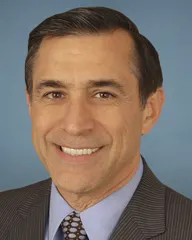
Darrell Issa
U.S. Representative for California's 48th District (Republican). In the House since 2001.
What they work on
- Government Operations and Politics7 bills
- International Affairs6 bills
- Commerce5 bills
What Darrell Issa did
The biggest votes
One Big Beautiful Bill Act
This bill reduces taxes, reduces or increases spending for various federal programs, increases the statutory debt limit, and otherwise addresses agencies and programs throughout the federal government.
What this bill does
Every Democrat voted no; nearly every Republican voted yes.
Rescissions Act of 2025
This bill rescinds $9.4 billion in unobligated funds that were provided to the Department of State, the U.S. Agency for International Development (USAID), various independent and related agencies, and the Corporation for Public Broadcasting.
What this bill does
Nearly every Democrat voted no; nearly every Republican voted yes.
Continuing Appropriations, Agriculture, Legislative Branch, Military Construction and Veterans Affairs, and Extensions Act, 2026
This act ends the government shutdown that began on October 1, 2025, by providing FY2026 continuing appropriations for most federal agencies through January 30, 2026, and providing appropriations through the end of FY2026 for agriculture, military construction and veterans affairs, and legislative branch programs.
What this bill does
Nearly every Democrat voted no; nearly every Republican voted yes.
What else they did
Nationwide Consumer and Fuel Retailer Choice Act of 2025
This bill amends the Clean Air Act to address the limitations on Reid Vapor Pressure (a measure of gasoline's volatility) that are placed on gasoline during the summer ozone season.
What this bill does
No Rogue Rulings Act or NORRA
This bill limits the authority of federal district courts to issue injunctions.
What this bill does
14 cosponsors, none from the other party.
A bill to take certain land in the State of California into trust for the benefit of the Pechanga Band of Indians, and for other purposes
This bill takes approximately 860 acres of land in Riverside County, California, into trust for the benefit of the Pechanga Band of Indians.
What this bill does
An amendment to the National Defense Authorization Act for Fiscal Year 2027
Amendment sought to authorize the Secretary to approve any eligible investor and cleared investment professional who meets the program's statutory and regulatory requirements to assess potential investment opportunities that match with the Department of War's requirements or potential requirements. It sought to make clear that the program is not capped, allowing an unlimited number of qualified investors, cleared personnel, and covered companies to participate at the discretion of the Secretary of War.
Epstein Files Transparency Act
This bill requires the Department of Justice (DOJ) to publish (in a searchable and downloadable format) all unclassified records, documents, communications, and investigative materials in DOJ's possession that relate to the investigation and prosecution of Jeffrey Epstein.
What this bill does
Money
Biggest PAC givers: Consumer Technology Association PAC and Edison International PAC
Raised $2.1 million for the 2026 election, through June 30, 2026; 19% came from PACs and other political committees.
Interest Rate Cap Transaction UBS
Votes through September 16, 2026. Campaign money through June 30, 2026.
In numbers
666 of 676 recorded votes98.5%
452 of 466 votes where the two parties disagreed97.0%
Bills since January 2025
- Sponsored
- 54
- Cosponsored
- 129
Stock trades
No stock trades reported since 2025 (1 that year).[filing]
- Individuals$775,227.24 (37.1%)
- PACs and other committees$387,700 (18.5%)
- Other receipts$927,293.78 (44.4%)
Cash on hand on June 30, 2026: $2.72 million
Sources: House Clerk, U.S. Government Publishing Office, Bill status bulk data: Senate bills, 119th Congress, Bill status bulk data: House joint resolutions, 119th Congress, Bill status bulk data: Senate joint resolutions, 119th Congress, Bill status bulk data: House concurrent resolutions, 119th Congress, Bill status bulk data: Senate concurrent resolutions, 119th Congress, Bill status bulk data: House simple resolutions, 119th Congress, Bill status bulk data: Senate simple resolutions, 119th Congress, House financial disclosure, House financial disclosure index, reporting year 2025 (2025FD.zip), House financial disclosure index, reporting year 2024 (2024FD.zip), House financial disclosure index, reporting year 2023 (2023FD.zip), House financial disclosure index, reporting year 2022 (2022FD.zip), House financial disclosure index, reporting year 2021 (2021FD.zip), House financial disclosure index, reporting year 2020 (2020FD.zip), House financial disclosure index, reporting year 2019 (2019FD.zip), Federal Election Commission, Contributions and independent expenditures from committees to candidates, 2025–2026 (pas226.zip), Committee master, 2025–2026 (cm26.zip)
All votes since January 2025Voted yes or no on 666 of 676 recorded votesShow details
Votes since January 2025
House votes from January 3, 2025, to September 16, 2026
- Attendance
- Voted yes or no on 666 of 676 (98.5%) recorded votes.Voted “present” 2 times. Did not vote 7 times.
- With their party
- Voted with most of their party on 452 of 466 (97.0%) votes where the two parties disagreed.
Source: House Clerk
Most recent votes
| Date | Question | Bill | Their vote | Result |
|---|---|---|---|---|
| Sep 16, 2026 | Passage under fast-track rules (two-thirds needed) Retire through Ownership Act What the bill doesRetire through Ownership Act
This bill allows the fiduciary of an Employee Stock Ownership Plan (ESOP) to rely on a valuation provided by an independent valuation expert or business appraiser in determining the fair market value of the plan's securities if the securities are not traded on a national securities exchange (i.e., not publicly traded) and the expert or appraiser follows specified methodologies.
In general, ESOPs are defined contribution pension plans where employees accrue shares of their employers' stock in individual accounts as part of their compensation. After separating from employment or retiring, employees receive the cash value of their shares.
Under the bill, an independent expert or appraiser must adhere to the methodology established under the Internal Revenue Service Ruling 59-60, which prescribes the factors a professional business appraiser should consider in forming a valuation of the stock for a closely held business. | S. 2403 | Yes | Passed 401 to 14[source] |
| Sep 16, 2026 | Passage under fast-track rules (two-thirds needed) Water Resources Development Act What the bill doesWater Resources Development Act of 2026
This bill authorizes and modifies certain water resource infrastructure projects and programs of the U.S. Army Corps of Engineers and makes related requirements. For example, the bill authorizes and modifies various water resources feasibility studies and projects of the Corps of Engineers, such as studies or projects to
- maintain ports and harbors,
- make certain waterways more navigable,
- reduce flood and storm damage,
- restore aquatic ecosystems and protect fish and wildlife,
- protect shorelines,
- address harmful algal blooms,
- rehabilitate dams,
- manage recreational sites and facilities,
- support water supply and storage projects, and
- support other water resources infrastructure.
The bill also directs the Corps of Engineers to establish an Office on Alternative Delivery Methods in order to accelerate project delivery of infrastructure.
In addition, the bill directs the Corps of Engineers to issue a rule that establishes categorical permissions for certain harbor or river improvements that will cause only minimal adverse environmental effects. | H.R. 9497 | Yes | Passed 415 to 9[source] |
| Sep 16, 2026 | Passage under fast-track rules (two-thirds needed) Ratepayer Protection Act What the bill doesRatepayer Protection Act
The bill requires state utility regulators and nonregulated utilities to consider implementing a standard to hold certain large-load customers responsible for the costs associated with any generation, transmission, or distribution upgrade of electric service necessary to serve such customers. A large-load customer means a non-residential electric consumer that enters, or requests to enter, an agreement concerning the sale of electric energy primarily to operate information technology infrastructure and related systems pertaining to data storage and computational applications and services (e.g., data centers) that have a peak electric demand of 100 megawatts or more at a single site or campus.
Specifically, the bill requires states to consider implementing a federal standard for large-load customers. The standard must require rates charged by electric utilities for providing electric service to a large-load customer to be designed to recover from the large-load customer the full, incremental cost of any generation, transmission, or distribution upgrade necessary to serve such customer. This rate must include the costs that would be incurred if the large-load customer terminates an agreement with the electric utility pertaining to the sale of electric energy or otherwise ceases the purchase of energy from the electric utility.
Under the standard, an electric utility must require the large-load customer to provide to the utility financial assurances or contributions to cover the cost of any generation, transmission, or distribution upgrade that is necessary to serve the load of a large-load customer before the utility makes any generation, transmission, or distribution upgrade. | H.R. 9340 | Yes | Passed 417 to 3[source] |
| Sep 16, 2026 | Final passageProviding for congressional disapproval under chapter 8 of title 5, United States Code, of the rule issued by the Environmental Protection… moreAgency relating to the “California State Nonroad Engine Pollution Control Standards; Commercial Harbor Craft Regulations; Notice of Decision”What the bill doesThis joint resolution revokes the partial authorization granted to the California Air Resources Board (CARB) to amend its Commercial Harbor Craft regulation. Among other elements, the amendments proposed by CARB and partially authorized by the Environmental Protection Agency (EPA) create new emission standards and compliance dates depending on vessel category and engine model year and expand the types of vessels covered by the regulation (e.g. commercial fishing boats). (Under the Clean Air Act, the EPA may authorize California to adopt and enforce standards relating to the control of emissions from nonroad vehicles or engines if those standards meet certain requirements.)
Specifically, the joint resolution nullifies the EPA authorization decision titled California State Nonroad Engine Pollution Control Standards; Commercial Harbor Craft Regulations; Notice of Decision. | H.J.Res. 213 | Yes | Passed 214 to 208[source] |
| Sep 16, 2026 | Final passage PROOF Act What the bill doesPreventing Rip-offs and Obtaining Oversight of Funds Act or the PROOF Act
This bill requires states to provide such information as the Department of Justice (DOJ) may require for the purpose of investigating or prosecuting alleged fraud committed with regard to certain federally funded programs.
Programs covered by this requirement include:
- Medicaid,
- Supplemental Nutrition Assistance Program (SNAP),
- Temporary Assistance for Needy Families (TANF),
- certain federal payments and grants to state governments related to the coronavirus response, and
- any other program to which funds are made available to states and identified by DOJ as vulnerable to fraud.
A federal agency may only use such information for law enforcement purposes related to fraud and may not disclose it for any unrelated administrative or commercial purpose.
DOJ must annually report to Congress on the number of requests for information issued to state agencies under this bill, the programs with respect to which such requests were made, and the number of fraud investigations initiated and convictions secured using the information obtained. | H.R. 10326 | Yes | Passed 217 to 207[source] |
| Sep 16, 2026 | Final passage National Fraud Enforcement Division Act What the bill doesNational Fraud Enforcement Division Act of 2026
This bill provides statutory authority for the National Fraud Enforcement Division within the Department of Justice (DOJ). The division investigates and prosecutes fraud against taxpayer dollars and taxpayer-funded programs.
The National Fraud Enforcement Division was established by DOJ in April 2026. | H.R. 9576 | Yes | Passed 352 to 72[source] |
| Sep 16, 2026 | Motion to Concur in the Senate Amendments An Act to amend the Internal Revenue Code of 1986 to allow early childhood educators to take the educator expense deduction, and for other purposes What the bill doesLindsey O. Graham Sanctioning Russia and Iran Act of 2026
This bill imposes a variety of sanctions, tariffs, and prohibitions related to Russia, extends an Iran-related sanctions law, and expands a tax deduction for teacher expenses to include early childhood educators.
For example, under the bill, the President must impose visa- and property-blocking sanctions on specified persons (individuals and entities) such as the Russian president and certain Russian military commanders. The President must also increase the rate of duty up to 100% ad valorem (i.e., relative to the value) on all goods imported into the United States from a country that was among the five largest importers of Russian-origin crude oil or natural gas if such country knowingly makes new purchases of such products after enactment of the bill.
The bill prohibits (1) the export, reexport, or in-country transfer to or in Russia of any U.S.-produced energy or energy product; (2) U.S. persons from making new investments in Russia or purchasing Russian sovereign debt; and (3) trading the securities of Russian government-owned, -controlled, or -affiliated entities on U.S. national securities exchanges.
The bill extends through 2031 the Iran Sanctions Act of 1996, which requires the President, with some exceptions, to impose sanctions on certain persons engaged in specified transactions related to Iran's energy sector or Iran's efforts to acquire or develop certain weapons.
The bill expands eligibility for federal tax deductions of certain educator expenses to early childhood educators providing educational or childcare services to those under age 6. | H.R. 5334 | Yes | Passed 262 to 159[source] |
| Sep 15, 2026 | Agreeing to the Resolution Directing the President, pursuant to section 5(c) of the War Powers Resolution, to remove United States Armed Forces from hostilities with Iran What the bill doesThis concurrent resolution directs the President to remove U.S. Armed Forces from hostilities against Iran unless explicitly authorized by a declaration of war or a congressional authorization for use of military force against Iran.
Elements of the U.S. Armed Forces needed to defend the United States, an ally, or a partner from imminent attack are not covered by this requirement provided the President complies with a specified provision of the War Powers Resolution. (The provision generally requires the President to remove U.S. Armed Forces from hostilities no more than 60 days after the President notifies or is required to notify Congress of such involvement, unless Congress authorizes such use. For more information on the War Powers Resolution, see CRS In Focus 13134.) | H.Con.Res. 93 | No | Passed 220 to 204[source] |
| Sep 15, 2026 | Final passageProviding for congressional disapproval under chapter 8 of title 5, United States Code, of the rule submitted by the Environmental… moreProtection Agency relating to “California State Nonroad Engine Pollution Control Standards; Ocean-Going Vessels At-Berth; Notice of Decision”What the bill doesThis joint resolution revokes the authorization granted to the California Air Resources Board (CARB) to amend its Ocean-Going Vessels At-Berth Regulation. Among other elements, the amendment proposed by CARB and authorized by the Environmental Protection Agency (EPA) expanded auxiliary engine emissions reductions requirements to include additional categories of ocean-going vessels. (Under the Clean Air Act, the EPA may authorize California to adopt and enforce standards relating to the control of emissions from nonroad vehicles or engines if those standards meet certain requirements.)
Specifically, the joint resolution nullifies the EPA authorization decision titled California State Nonroad Engine Pollution Control Standards; Ocean-Going Vessels At-Berth; Notice of Decision. | H.J.Res. 210 | Yes | Passed 216 to 211[source] |
| Sep 15, 2026 | Passage under fast-track rules (two-thirds needed) Tax Relief for Fraud Victims Act What the bill doesTax Relief for Fraud Victims Act
This bill expands the federal tax deduction for personal casualty and theft losses by eliminating certain limits, including the requirement that such losses arise from certain disasters. The bill also extends the tax refund deadline and modifies certain retirement plan rules related to certain fraud losses.
The bill repeals the limit on the federal tax deduction for personal casualty losses (not attributable to a trade, business, or transaction entered into for profit) that allows such losses only if arising from a federal or state declared disaster or to the extent that such losses offset personal casualty gains.
The bill allows taxpayers to elect to claim a tax deduction for losses arising from a theft involving fraud, deceit, or misrepresentation in the tax year such losses occur (rather than in the tax year discovered). Further, the bill extends the deadline for a refund claim related to a tax deduction for such losses to no less than one year after the date on which the losses are discovered and eliminates certain restrictions on the amount of such refund.
For early distributions from a qualified retirement plan arising from a theft loss involving fraud, deceit, or misrepresentation for which a tax deduction is allowed, the bill
- waives the 10% penalty,
- extends the deadline for filing a refund claim and eliminates certain restrictions on the amount of such refund, and
- allows one year (beginning on the day after the theft loss is discovered) to repay such early distributions. | H.R. 9500 | Yes | Passed 408 to 17[source] |
Votes on bills they sponsored
All billsSponsored 54Show details
Bills since January 2025
- Sponsored
- 54 bills and resolutions
- Cosponsored
- 129 bills and resolutions
Sources: U.S. Government Publishing Office, Bill status bulk data: Senate bills, 119th Congress, Bill status bulk data: House joint resolutions, 119th Congress, Bill status bulk data: Senate joint resolutions, 119th Congress, Bill status bulk data: House concurrent resolutions, 119th Congress, Bill status bulk data: Senate concurrent resolutions, 119th Congress, Bill status bulk data: House simple resolutions, 119th Congress, Bill status bulk data: Senate simple resolutions, 119th Congress
Sponsored, most recently introduced first
American Copyright Protection Act of 2026
Introduced September 14, 2026. In committee; no vote yet. Last action on September 14, 2026.[source]
Introduced September 8, 2026. In committee; no vote yet. Last action on September 8, 2026.[source]
To provide for the continued use of certain trust land in San Diego County for healthcare purposes.
Introduced September 1, 2026. In committee; no vote yet. Last action on September 1, 2026.[source]
Honoring Circuit Judge Pauline Newman Act of 2026
Introduced August 3, 2026. In committee; no vote yet. Last action on August 3, 2026.[source]
Preventing Abuse of Digital Replicas Act
Introduced August 3, 2026. In committee; no vote yet. Last action on August 3, 2026.[source]
Designating an official residence for the Speaker of the House of Representatives.
Introduced July 9, 2026. In committee; no vote yet. Last action on July 9, 2026.[source]
To authorize the Development Finance Corporation to invest in Venezuela.
Introduced May 21, 2026. In committee; no vote yet. Last action on May 21, 2026.[source]
Sergeant Rafael Peralta Medal of Honor Authorization Act
Introduced May 21, 2026. In committee; no vote yet. Last action on May 21, 2026.[source]
Congressional Apportionment Amendment Deadline Act
Introduced May 14, 2026. In committee; no vote yet. Last action on May 14, 2026.[source]
Pechanga Band of Indians Water Rights Settlement Technical Amendments Act
Introduced April 28, 2026. In committee; no vote yet. Last action on September 10, 2026.[source]
Barona Group of Capitan Grande Band of Mission Indians Land Transfer Act of 2026
Introduced April 23, 2026. Approved by a committee. Last action on September 15, 2026.[source]
Expunging the December 18, 2019, and January 13, 2021, Impeachments of President Donald Trump.
Introduced April 23, 2026. In committee; no vote yet. Last action on April 23, 2026.[source]
Protecting American Competition Act of 2026
Introduced April 15, 2026. Approved by a committee. Last action on April 22, 2026.[source]
Lebanon Election Integrity and Diaspora Voting Protection Act of 2026
Introduced February 2, 2026. In committee; no vote yet. Last action on February 2, 2026.[source]
Introduced January 14, 2026. Approved by a committee. Last action on January 21, 2026.[source]
…and 39 more sponsored items.
Most recent cosponsorships
Cosponsored October 5, 2026 (original cosponsor). In committee; no vote yet. Last action on October 5, 2026.[source]
North Platte Canteen Congressional Gold Medal Act
Cosponsored September 24, 2026. In committee; no vote yet. Last action on February 21, 2025.[source]
America’s Olympic and Paralympic Games Commemorative Coins Act
Cosponsored September 10, 2026. In committee; no vote yet. Last action on July 14, 2025.[source]
Securing Innovation and Research from Adversaries Act
Cosponsored September 8, 2026. In committee; no vote yet. Last action on May 19, 2026.[source]
Cosponsored September 2, 2026. Passed the House; waiting in the Senate. Last action on September 16, 2026.[source]
Cosponsored August 31, 2026. In committee; no vote yet. Last action on August 27, 2026.[source]
Cosponsored August 20, 2026 (original cosponsor). In committee; no vote yet. Last action on August 20, 2026.[source]
Cosponsored August 17, 2026 (original cosponsor). In committee; no vote yet. Last action on August 17, 2026.[source]
Great American Outdoors Act 250
Cosponsored August 3, 2026. Approved by a committee. Last action on June 24, 2026.[source]
Cosponsored July 23, 2026 (original cosponsor). In committee; no vote yet. Last action on July 23, 2026.[source]
…and 119 more cosponsorships.
Campaign money$2.09 million raisedShow details
Campaign money, 2025 and 2026
House campaign, with activity through June 30, 2026. See it on FEC.gov ↗
The campaign's totals
- Raised
- $2,090,221.02
- Spent
- $1,019,227.41
- Cash on hand on June 30, 2026
- $2,715,609.93
- Debts
- $5,024,682.17
Where the money came from
- Individuals
- $775,227.24
- PACs and other committees
- $387,700
Top contributing committees
The FEC reports $387,700 from PACs and other committees. The largest givers:
| Committee | Amount |
|---|---|
| Consumer Technology Association PACPAC, 4 contributions | $15,000 |
| Edison International PACPAC, 2 contributions | $10,000 |
| Space Exploration Technologies Corp. PACPAC, 2 contributions | $10,000 |
| American Institute of Certified Public Accountants Political Action CommitteePAC, 2 contributions | $7,500 |
| National Music Publishers' Association, Inc. Political Action Committee (NMPAC)PAC, 3 contributions | $6,500 |
| American Seniors Housing Association (SENIORS HOUSING PAC)PAC, 5 contributions | $5,000 |
| Republican Mainstreet Partnership PACPAC, 5 contributions | $5,000 |
| Dell Technologies, Inc. Political Action CommitteePAC, 4 contributions | $5,000 |
| American Revival PACPAC, 3 contributions | $5,000 |
| Science Applications International Corporation Voluntary Political Action CommitteePAC, 3 contributions | $5,000 |
Outside spending
Outside groups spent $3,550 opposing them (2 groups).
| Committee | Amount |
|---|---|
| Activate America3 expenditures | $3,487 |
| Voter to Voter PAC3 expenditures | $63 |
Sources: Federal Election Commission, Contributions and independent expenditures from committees to candidates, 2025–2026 (pas226.zip), Committee master, 2025–2026 (cm26.zip)
Stock trades and holdings20 purchases and salesShow details
Stock trades and holdings
Filed 3 stock trade reports from 2019 to 2026.
- 2025
- 1
- 2024
- 12
- 2023
- 7
| Trade date | Owner | Asset | Type | Amount (range) | Reported |
|---|---|---|---|---|---|
| Apr 10, 2025 | Self | Interest Rate Cap Transaction UBS | Sale | $25,000,001 – $50,000,000 | Apr 17, 2025[PDF] |
| Aug 5, 2024 | Self | United States Treasury Bills CUSIP 912797KB2 due 8/15/24 | Sale | $5,000,001 – $25,000,000 | Sep 26, 2024[PDF]Reported 52 days after the trade; the law allows 45. |
| Jun 5, 2024 | Self | United States Treasury Bills CUSIP 912797KE6 due 6/11/24 | Sale | $1,000,001 – $5,000,000 | Sep 26, 2024[PDF]Reported 113 days after the trade; the law allows 45. |
| May 20, 2024 | Self | United States Treasury Bills CUSIP 912797JZ1 due 6/4/24 | Sale | $1,000,001 – $5,000,000 | Sep 26, 2024[PDF]Reported 129 days after the trade; the law allows 45. |
| Mar 14, 2024 | Self | United States Treasury Bills CUSIP 912797GZ4 due 4/4/24 | Sale | $5,000,001 – $25,000,000 | Sep 26, 2024[PDF]Reported 196 days after the trade; the law allows 45. |
| Mar 14, 2024 | Self | United States Treasury Bills CUSIP 912797HF7 due 4/11/24 | Sale | $5,000,001 – $25,000,000 | Sep 26, 2024[PDF]Reported 196 days after the trade; the law allows 45. |
| Mar 6, 2024 | Self | United States Treasury Bills CUSIP 912797GY7 due 3/28/24 | Sale | $5,000,001 – $25,000,000 | Sep 26, 2024[PDF]Reported 204 days after the trade; the law allows 45. |
| Mar 6, 2024 | Self | United States Treasury Bills CUSIP 912797GZ4 due 4/4/24 | Partial sale | $1,000,001 – $5,000,000 | Sep 26, 2024[PDF]Reported 204 days after the trade; the law allows 45. |
| Mar 6, 2024 | Self | United States Treasury Bills CUSSIP 912797GX9 due 3/14/24 | Sale | $5,000,001 – $25,000,000 | Sep 26, 2024[PDF]Reported 204 days after the trade; the law allows 45. |
| Feb 27, 2024 | Self | United States Treasury Bills CUSIP 912797GP6 due 2/29/24 | Sale | $1,000,001 – $5,000,000 | Sep 26, 2024[PDF]Reported 212 days after the trade; the law allows 45. |
| Feb 13, 2024 | Self | United States Treasury Bills CUSIP 912797GN1 due 2/15/24 | Sale | $5,000,001 – $25,000,000 | Sep 26, 2024[PDF]Reported 226 days after the trade; the law allows 45. |
| Feb 5, 2024 | Self | United States Treasury Bills CUSIP 912797GM3 due 2/8/24 | Sale | $1,000,001 – $5,000,000 | Sep 26, 2024[PDF]Reported 234 days after the trade; the law allows 45. |
| Jan 24, 2024 | Self | United States Treasury Bills CUSIP 912797JB4 due 1/30/24 | Sale | $1,000,001 – $5,000,000 | Sep 26, 2024[PDF]Reported 246 days after the trade; the law allows 45. |
| May 2, 2023 | Self | Treasury Bill CUSIP 91279FN2 due 6/13/23 | Sale | $5,000,001 – $25,000,000 | Sep 25, 2024[PDF]Reported 512 days after the trade; the law allows 45. |
| May 2, 2023 | Self | US Treasury Bill CUSIP 912796ZG7 due 6/1/23 | Sale | $5,000,001 – $25,000,000 | Sep 25, 2024[PDF]Reported 512 days after the trade; the law allows 45. |
| Mar 24, 2023 | Self | Treasury Bill CUSIP 912796YN3 due 4/6/23 | Partial sale | $5,000,001 – $25,000,000 | Sep 25, 2024[PDF]Reported 551 days after the trade; the law allows 45. |
| Mar 15, 2023 | Self | Treasury Bill CUSIP 912796YN3 due 4/6/23 | Partial sale | $5,000,001 – $25,000,000 | Sep 25, 2024[PDF]Reported 560 days after the trade; the law allows 45. |
| Mar 10, 2023 | Self | Treasury Bill CUSIP 912796YN3 Due 4/6/23 | Partial sale | $5,000,001 – $25,000,000 | Sep 25, 2024[PDF]Reported 565 days after the trade; the law allows 45. |
| Feb 23, 2023 | Self | Treasury Bill CUSIP 912796YN3 due 4/6/23 | Partial sale | $5,000,001 – $25,000,000 | Sep 25, 2024[PDF]Reported 580 days after the trade; the law allows 45. |
| Feb 9, 2023 | Self | Treasury Bill CUSIP 912796YN3 due 4/6/23 | Partial sale | $5,000,001 – $25,000,000 | Sep 25, 2024[PDF]Reported 594 days after the trade; the law allows 45. |
Holdings in their 2025 annual report, filed August 14, 2026[PDF]
| Asset | Owner | Value (range) | Income type |
|---|---|---|---|
| 1200 Harbor Dr, LP | Self | $500,001 – $1,000,000 | None |
| 1800 Carillon Blvd, LP | Self | $1,000,001 – $5,000,000 | Rent |
| 212 Main St LP | Self | $1,000,001 – $5,000,000 | Rent |
| 25 D St SE LP | Self | $1,000,001 – $5,000,000 | Rent |
| 2585 Business Park LP | Self | None | None |
| 447 New Jersey Ave SE Washington DC | Self | $1,000,001 – $5,000,000 | Rent |
| Congressional Federal credit Union Account | Self | $250,001 – $500,000 | Interest |
| DEI Investments, LLC | Self | None | None |
| DEI, LLC | Self | $100,001 – $250,000 | Partnership Income |
| Greene Properties, Inc,, 100% Interest | Self | $100,001 – $250,000 | None |
| Interest Rate Cap Transaction UBS | Self | None | Capital Gains |
| Ocean Collection LP | Self | $5,000,001 – $25,000,000 | Capital Gains, Rent |
| Tahoe Beach LP | Self | $1,000,001 – $5,000,000 | None |
| B of A Finance LLC L/O TC-YN NDX RTY 2/19/27in Account 1-Investment account-496 | Self | $25,000,001 – $50,000,000 | Interest |
| B of A Finance LLC L/O TC-YN NDX RTY 01/22/27in Account 1-Investment account-496 | Self | $5,000,001 – $25,000,000 | Interest |
| B of A Finance LLC L/O TC-YN NDX RTY 2/24/27in Account 1-Investment account-496 | Self | $5,000,001 – $25,000,000 | Interest |
| B of A Finance LLC L/O TC-YN RTY 06/10/26in Account 1-Investment account-496 | Self | None | Capital Gains, Interest |
| B Oof A Finance LLC L/O TC-YN NDX RTY 02/10/27in Account 1-Investment account-496 | Self | $5,000,001 – $25,000,000 | Interest |
| BNP Paribas T-IDN C01 10/30/26in Account 1-Investment account-496 | Self | $5,000,001 – $25,000,000 | None |
| BNP Paribas T-IDN C01 12/29/26in Account 1-Investment account-496 | Self | $1,000,001 – $5,000,000 | None |
| BNP Paribas T-IDN C01 9/30/26in Account 1-Investment account-496 | Self | $5,000,001 – $25,000,000 | None |
| BNP Paribas T-IDN CO1 5/30/25in Account 1-Investment account-496 | Self | None | Capital Gains |
| BNP Paribas T-IDN CO1 6/30/25in Account 1-Investment account-496 | Self | None | Capital Gains |
| Citigroup Global Markets L/O TC-YN NDX RTY 01/15/27in Account 1-Investment account-496 | Self | $5,000,001 – $25,000,000 | Interest |
| GS Finance Corp t-IDN CO1 04/17/25in Account 1-Investment account-496 | Self | None | Capital Gains |
| HSBC USA Inc L/O TC-YN NDX RTY 2/16/27in Account 1-Investment account-496 | Self | $5,000,001 – $25,000,000 | Interest |
| Insured Sweep Programin Account 1-Investment account-496 | Self | $500,001 – $1,000,000 | Interest |
| JP Morgan Chase Financial T-IDN C01 12/29/26in Account 1-Investment account-496 | Self | $1,000,001 – $5,000,000 | None |
| JP Morgan Chase Financial T-IDN C01 9/30/26in Account 1-Investment account-496 | Self | $25,000,001 – $50,000,000 | None |
| JP Morgan Chase Financial T-IDN CO1 10/31/25in Account 1-Investment account-496 | Self | None | Capital Gains |
Showing 30 of 54 assets; the rest are in the linked filing.
Sources: House financial disclosure, House financial disclosure index, reporting year 2025 (2025FD.zip), House financial disclosure index, reporting year 2024 (2024FD.zip), House financial disclosure index, reporting year 2023 (2023FD.zip), House financial disclosure index, reporting year 2022 (2022FD.zip), House financial disclosure index, reporting year 2021 (2021FD.zip), House financial disclosure index, reporting year 2020 (2020FD.zip), House financial disclosure index, reporting year 2019 (2019FD.zip)
Their work since January 2025Show details
Their work since January 2025
Spoke on the floor 11 times on 8 days.[source] Topics included “IN REMEMBRANCE OF THE HONORABLE DOUG LaMALFA,” “National Defense Authorization Act for Fiscal Year 2027,” and “Department of Defense Appropriations Act, 2026.”[source] Filed 4 written statements for the Record.[source]
Offered 1 amendment on the floor; it was not adopted.[the amendment]
Sits on the Judiciary Committee (84 hearings and 19 bill-drafting sessions, counting subcommittees) and the Foreign Affairs Committee (81 hearings, 9 bill-drafting sessions).[Judiciary][Foreign Affairs]
Signed none of the 27 discharge petitions filed since January 2025.[source]
Their office spent $1.82 million of its $1.93 million budget for 2025, or 94% (the typical House office spent 97%), as reported through June 30, 2026.[spending][budget] Staff pay took $74 of every $100 (typical: $75).[spending] Official mail cost $28,047 (typical: $18,550).[spending]
Lobbyists reported $370,960 in 180 contributions in 2025 to their campaign or their leadership PAC.[source]
Floor speeches through October 5, 2026.
Senate Office of Public Records cannot vouch for the data or analyses derived from these data after the data have been retrieved from LDA.gov. Retrieved from LDA.gov on October 6, 2026.
Committees3 committeesShow details
Committees
- Committee on Foreign AffairsMajority member
- Subcommittee on Middle East and North AfricaMajority member
- Subcommittee on Oversight and IntelligenceMajority member
- Committee on Science, Space, and TechnologyMajority member
- Subcommittee on Research and TechnologyMajority member
- Subcommittee on Investigations and OversightMajority member
- Committee on the JudiciaryMajority member
- Subcommittee on Courts, Intellectual Property, Artificial Intelligence, and the InternetChair
- Subcommittee on The Administrative State, Regulatory Reform, and AntitrustMajority member
Source: House Clerk
More about themShow details
More about them
- Sworn in
- January 3, 2025 (current term)
- Next election
- 2026
- Born
- 1953
- Office in Washington
- 2108 Rayburn House Office Building
Sources: House Clerk, Library of Congress